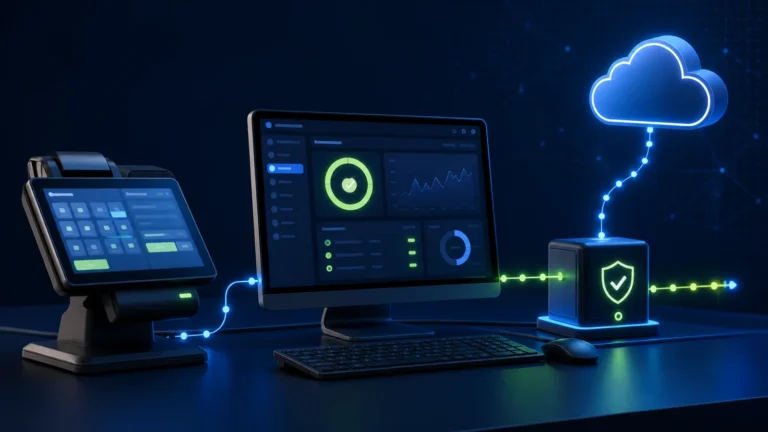

A PRA eIMS operations dashboard should show business impact, not just server uptime. Track accepted, rejected, uncertain and queued invoices; oldest pending age; duplicate-risk events; branch and counter health; SFD/API availability; response latency; receipt failures; reconciliation differences and configuration changes. Every alert should open a short runbook with an owner, safe diagnostics, escalation evidence, recovery test and reconciliation step.
Reviewed 28 August 2026. These are operational monitoring recommendations, not official PRA service-level commitments. Confirm supported status behavior, endpoints and escalation channels for the actual deployment.
Monitor the customer transaction end to end
Sale authorized → payload validated → submission attempted → fiscal result stored → receipt printed → invoice reconciled
A green Windows service does not prove invoices are accepted. A fast API call does not prove receipts contain the correct fiscal reference. Monitoring must connect technical signals to transaction status.
Dashboard scorecard
| Metric | Why it matters | Useful view |
|---|---|---|
| Accepted invoices | Confirms completed fiscal workflow | Count and value by branch/counter |
| Rejected invoices | Shows data or configuration problems | Top error category and age |
| Uncertain invoices | Indicates duplicate risk | Immediate exception queue |
| Queued/pending invoices | Shows backlog and continuity risk | Count plus oldest age |
| Submission latency | Detects degradation before failure | Median and high percentile |
| SFD/local health | Separates local service incidents | Per-device heartbeat |
| Receipt failures | Customer output can fail after acceptance | Print errors and reprint count |
| Reconciliation difference | Connects fiscal status to money | Value by shift/day |
| Configuration changes | Explains sudden branch-wide failures | Timeline with actor |
Status definitions must be consistent
Define status centrally. “Pending” should not mean one thing in the cashier UI and another in support reports. Include Draft, Ready, Submitting, Accepted, Rejected, Uncertain, Queued and Escalated where they fit the architecture. Document which event moves an invoice between states.
Alert on age and impact
A single rejected test invoice may be low urgency; one uncertain production invoice is high risk; a queue growing across all branches can be critical. Alerts should combine count, age, environment, branch scope and financial value.
| Alert | Initial priority | Owner |
|---|---|---|
| Any uncertain invoice | High until resolved | POS support plus finance |
| Oldest queue exceeds approved threshold | Medium/high by business impact | Operations |
| All counters at one branch unhealthy | High | Branch manager and IT |
| Authentication/TLS failures | High; possible configuration/security incident | System owner |
| Repeated duplicate-risk lock | High | Application owner |
| Reconciliation difference | High at closing | Finance and branch management |
| Disk space or log failure | Medium before service impact | IT operations |
Set actual thresholds from transaction volume and approved continuity objectives; do not copy arbitrary numbers from another business.
Runbook template
- Trigger: exact alert condition and environment.
- Impact: branches, counters, invoice count/value and customer effect.
- Owner: named primary and escalation contact.
- Safety warning: actions that could duplicate or alter invoices.
- Diagnostics: ordered checks with expected output.
- Evidence: USIN, timestamps, status, version and redacted errors.
- Mitigation: approved continuity action.
- Recovery: health and controlled transaction tests.
- Reconciliation: confirm every affected invoice.
- Closure: root cause, corrective action and review date.
Runbook: local SFD unavailable
- Stop automatic or cashier-driven repeated submissions.
- Confirm affected device and last known healthy time.
- Check service state, local endpoint, disk and recent change history.
- Preserve logs before restart.
- Restart once under the approved procedure if appropriate.
- Run a health check and controlled test.
- Review the queue and uncertain statuses.
- Reconcile before closing the incident.
See the local SFD deployment and health-check guide.
Runbook: timeout or unknown result
- Mark the invoice Uncertain and lock its USIN.
- Check the local attempt record and fiscal response store.
- Use available invoice verification or reconciliation evidence.
- Do not generate a replacement sale.
- Escalate with a redacted evidence pack.
- Recover according to the supported behavior.
- Verify receipt and payment records.
Use the PRA invoice idempotency and retry guide.
Runbook: branch-wide rejection spike
Check for a recent configuration release, POSID mapping, expired or rotated credential, endpoint/environment mistake, clock issue or item-master change. Compare one failing branch with a healthy branch without copying credentials between them. Roll back only through an approved change path.
Logging without leaking secrets
- Record USIN, POSID, branch, counter, environment and timestamps.
- Redact tokens, passwords, PINs and authorization headers.
- Protect buyer data and card-related information.
- Capture configuration version rather than secret value.
- Restrict who can export raw logs.
The PRA POS audit-log guide provides a retention and evidence model.
Daily operational review
- Check unresolved alerts and oldest pending age.
- Review uncertain and manually retried invoices.
- Compare accepted fiscal totals with POS and payment totals.
- Review returns, voids, discounts and reprints.
- Confirm every active branch is reporting.
- Record exceptions, owners and target resolution.
Post-incident review
Document the timeline, affected transactions, detection gap, actions, recovery evidence and reconciliation. Improve the monitor or runbook so the same failure is detected earlier and resolved more safely. Assign a review date and test the updated runbook in sandbox.
Official references
- PRA Software Fiscal Device Technical Specification version 1.2
- Official PRA POS invoice search
- Official PRA contact information
Frequently asked questions
Is API uptime enough for PRA monitoring?
No. Track invoice status, queue age, receipt outcome and reconciliation in addition to technical availability.
What is the most urgent status?
An uncertain production invoice deserves immediate attention because the result is unknown and a careless retry can create duplicate risk.
Should every alert restart the SFD automatically?
No. Restarting can obscure evidence and does not fix payload, credential, TLS or reconciliation problems. Use a diagnosis-specific runbook.
How often should runbooks be tested?
Test them after material system changes and on a regular schedule in a safe environment. Update ownership and links whenever teams or architecture change.
Need visibility across PRA POS operations?
NexZion Solutions can design status dashboards, queue alerts, incident evidence, branch monitoring and reconciliation workflows.
Continue: Explore the PRA POS Integration Software resource center for registration, SFD, testing, troubleshooting and industry workflows.
NexZion Solutions publishes practical guides based on business-software, compliance-workflow, website and automation implementation experience in Pakistan.