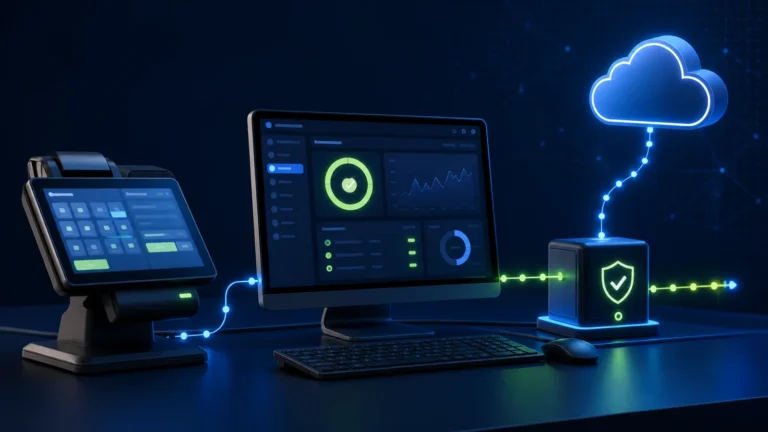

FBR and PRA integrations are only complete when accepted invoices reconcile with POS, ERP, stock, payments and accounts. Daily exception handling prevents rejected, duplicated or missing fiscal records from becoming a month-end crisis.
Five records that should agree
| Record | What it proves |
|---|---|
| Business invoice | What the POS or ERP approved and issued |
| Authority submission | What data was sent to FBR or PRA |
| Authority response | Accepted, rejected, pending or unknown result and reference |
| Financial posting | Revenue, tax, receivable, cash or bank impact |
| Operational movement | Stock, service order, return or other linked business effect |
Daily reconciliation checklist
- Count business invoices by entity, branch and integration route.
- Count accepted authority submissions.
- List rejected, pending, timed-out and unknown submissions.
- Compare invoice value, tax value and line counts.
- Review returns and corrections linked to original invoices.
- Identify duplicate business or authority references.
- Compare cash, card, bank and credit payments with invoices.
- Compare sales and returns with inventory movement.
- Resolve exceptions or assign an owner and deadline.
- Close the day only after authorised review.
Recommended reconciliation report columns
- legal entity and registration;
- branch, outlet and POS;
- business invoice number and date;
- invoice/return type;
- buyer and transaction classification;
- net value, tax and gross value;
- authority route;
- submission correlation ID;
- authority response reference;
- accepted, rejected, pending or unknown status;
- attempt count and last error;
- financial posting and payment status;
- exception owner and resolution note.
Rejected invoice process
- Preserve the original invoice and rejection response.
- Classify the cause: data, configuration, scenario, credentials or connectivity.
- Confirm whether the business transaction itself is correct.
- Correct master/configuration data through approval.
- Follow the authority’s current resubmission or correction procedure.
- Store the new attempt without deleting history.
- Confirm the final response and update the exception queue.
Duplicate-prevention controls
- unique immutable internal invoice ID;
- idempotent submission/correlation key where supported;
- one active submission route per applicable invoice;
- retry lock while status is unknown;
- search by business invoice before manual resend;
- supervisor approval for exceptional resubmission;
- duplicate-reference and duplicate-value alerts;
- daily review of repeated attempts.
Returns and credit adjustments
Returns should identify the original invoice, items or services returned, quantities, values and reason. The business return, stock reversal, customer balance, payment/refund and authority transaction should remain connected.
Month-end controls
- no unexplained pending or unknown submissions;
- rejected invoices resolved or formally carried with ownership;
- accepted counts and totals reconciled by authority and branch;
- returns linked and reconciled;
- sales, tax, receivables and payments reconciled;
- stock movement reconciled for goods transactions;
- sequence gaps and duplicates explained;
- credentials and system logs retained securely;
- management sign-off documented.
Management dashboard
Show accepted value, rejected count, pending age, retry volume, duplicate alerts and branch exceptions. The dashboard should allow drill-down to each business invoice and response rather than displaying totals without evidence.
Frequently asked questions
Should FBR and PRA totals be combined?
Management may view consolidated business sales, but reconciliation should remain separated by authority, entity, branch and applicable transaction route.
Can reconciliation be automated?
Yes. Automated matching can identify differences, while authorised staff investigate and resolve exceptions.
What if the authority response is unknown after a timeout?
Do not blindly create another invoice. Preserve the attempt, check available status facilities and follow the current approved support/retry procedure.
Can NexZion build an exception dashboard?
Yes. NexZion can scope dashboards, alerts and reconciliation reports for supported POS, ERP and integration data sources.
Improve your FBR and PRA reconciliation
Share sample invoice statuses, current reports, branches and recurring errors. NexZion Solutions will recommend exception controls and reporting.
Reviewed: August 2026. Reconciliation procedures should reflect current official requirements and accounting policies.
NexZion Solutions publishes practical guides based on business-software, compliance-workflow, website and automation implementation experience in Pakistan.