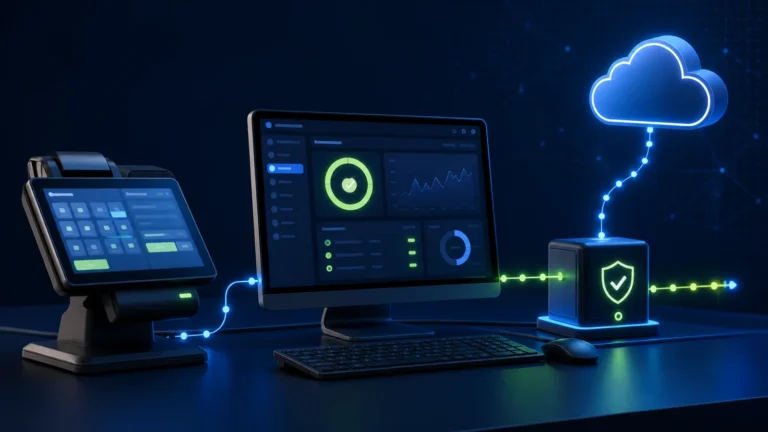
FBR Digital Invoicing and PRA eIMS/POS integration are different government invoicing workflows. They may both involve electronic invoice data, validation references and QR information, but they serve different authorities, registrations, tax scopes and technical processes.
FBR Digital Invoicing versus PRA eIMS at a glance
| Area | FBR Digital Invoicing | PRA eIMS/POS |
|---|---|---|
| Authority | Federal Board of Revenue | Punjab Revenue Authority |
| Primary context | Federal sales-tax digital invoice reporting according to applicable FBR rules and onboarding | Punjab sales-tax-on-services fiscalisation/POS workflow for applicable service providers |
| Technical reference | FBR/PRAL Digital Invoicing API documentation and portal workflow | PRA Software Fiscal Device specification and eIMS portal workflow |
| Integration pattern | Structured invoice submission through the configured FBR/PRAL route | POS connects to the configured PRA software fiscal-device process |
| Returned reference | FBR response/reference according to the current interface | PRA fiscal invoice number according to the current fiscal-device specification |
| Business decision | Confirm federal registration and current applicability | Confirm Punjab service registration and current applicability |
Official technical references
The current public FBR Technical Specification for DI API v1.12 describes the Digital Invoicing API structure and validation workflow. The FBR Digital Invoicing User Manual explains taxpayer, licensed-integrator and system workflows.
The PRA Software Fiscal Device specification describes POS registration, test IDs, the local fiscal-device service, PRA invoice response and QR receipt process.
How the FBR Digital Invoicing workflow operates
- Confirm taxpayer onboarding and applicable invoice scenarios.
- Prepare seller, buyer, item, tax and transaction master data.
- Create the business invoice in POS, ERP or invoicing software.
- Map the invoice to the current FBR Digital Invoicing structure.
- Validate and submit through the configured integration route.
- Store the complete request, response and FBR reference.
- Print or share the approved invoice format and QR information.
- Reconcile business invoices with accepted, rejected and pending submissions.
How the PRA eIMS/POS workflow operates
- Confirm PRA registration, service classification, branches and current applicability.
- Register the applicable POS and branch information through the PRA process.
- Prepare test POS IDs and sandbox configuration where required.
- Install/configure the PRA software fiscal device on the applicable system.
- Send the completed POS invoice to the local fiscalisation service.
- Store the returned PRA fiscal invoice number.
- Print the fiscal number and QR code on the customer receipt.
- Reconcile POS invoices, fiscal status, returns and daily payments.
Why one invoice cannot simply be sent everywhere
Authorities can require different fields, identifiers, transaction classifications and response handling. The business invoice should remain the controlled commercial record, while each required integration receives a mapped payload appropriate to its authority.
- different seller registrations;
- different buyer identification requirements;
- different item or service classifications;
- different tax rates and calculations;
- different invoice and return scenarios;
- different credentials, endpoints and environments;
- different response numbers and QR content;
- different reconciliation and support procedures.
Common mistakes
- assuming “FBR integrated” automatically means PRA integrated;
- using the same tax configuration for goods and services without advice;
- mixing branches or registrations in one uncontrolled counter;
- printing a QR code without preserving the authority response;
- retrying failed invoices in a way that creates duplicates;
- editing an accepted invoice instead of using the approved return/correction process;
- allowing staff to select tax scenarios without permissions;
- reconciling only sales totals and ignoring rejected submissions.
Frequently asked questions
Is FBR Digital Invoicing the same as PRA POS integration?
No. They are separate authority and technical workflows. A software provider should explain and demonstrate each connection separately.
Can one company require both FBR and PRA integration?
Potentially, depending on registrations, activities, branches and current rules. Obtain professional advice before configuration.
Can NexZion integrate existing ERP or POS software?
Yes, subject to system access, data quality, APIs or source-code availability and an agreed implementation scope.
Should the invoice show two government references?
That depends on the applicable transaction and approved process. Do not design the receipt until the legal and technical requirements are confirmed.
Discuss FBR and PRA integration for your business
Send your city, registrations, business activities, branches, invoice types and current software. NexZion Solutions will help define the technical scope and demonstration.
Discuss FBR and PRA on WhatsApp | Request an integration consultation
Reviewed: August 2026. This guide provides technical and operational information, not tax or legal advice.
NexZion Solutions publishes practical guides based on business-software, compliance-workflow, website and automation implementation experience in Pakistan.