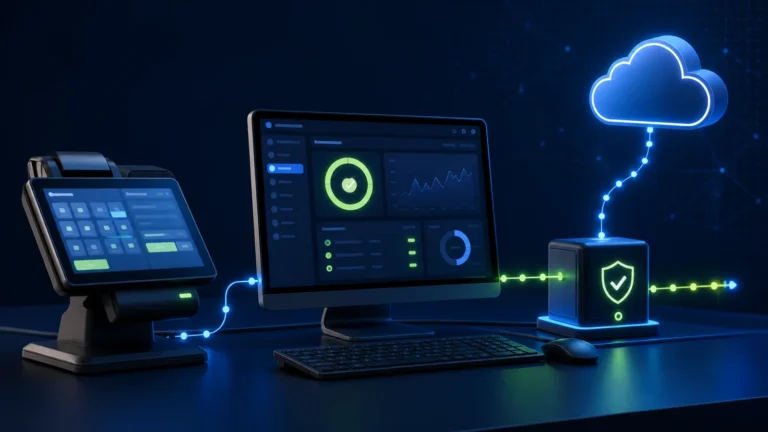

One POS or ERP can support FBR and PRA workflows, but it should not treat them as the same integration. A professional design keeps the business invoice, authority mapping, credentials, validation, responses, retries and reconciliation separate.
Recommended multi-authority architecture
- Business transaction layer: POS, ERP or invoicing system creates the approved commercial invoice.
- Classification layer: seller, branch, activity, buyer and transaction scenario determine the configured route.
- Validation layer: required fields, formats, identifiers and calculations are checked before submission.
- Authority adapter: the system maps to FBR Digital Invoicing, FBR POS, PRA eIMS/POS or another configured workflow.
- Response layer: requests, responses, references, errors and timestamps are preserved.
- Document layer: the correct reference and QR information are printed or shared.
- Reconciliation layer: business invoices are compared with authority status and financial records.
Configuration that must remain separate
| Configuration | Why separation matters |
|---|---|
| Legal entity | Each taxpayer has its own registrations and records |
| Branch/outlet | Transactions must use the correct location and POS identity |
| Authority credentials | Access must not be shared across unrelated workflows |
| Environment | Sandbox and production submissions must never mix |
| Tax mapping | Goods, services, rates and scenarios require approved treatment |
| Numbering/reference | Business and authority references serve different purposes |
| Error handling | Rejections and retry rules differ by interface |
| Receipt template | Displayed fields and QR information depend on the workflow |
Master data needed for both integrations
- seller legal and registration data;
- branches, outlets, POS devices and warehouses;
- buyers and their registration types;
- products, services, units and classifications;
- approved tax rates and scenarios;
- invoice, return and adjustment types;
- payment methods where operationally required;
- users, roles and approval limits.
Routing rules
Routing should be deterministic and approved. A cashier should not choose “send to FBR” or “send to PRA” from memory for every invoice. The software should derive the route from controlled configuration and ask for additional information only when necessary.
- seller/legal entity;
- registered branch;
- product or service classification;
- buyer type;
- invoice scenario;
- effective date;
- approved exception rule.
Failure and retry design
Authority downtime must not cause duplicate business invoices. Give each submission an internal correlation ID and preserve every attempt. Distinguish validation rejection, connectivity failure, timeout, accepted response and unknown status.
- Validate locally before transmission.
- Store the immutable business invoice.
- Create one submission record for the intended authority.
- Record request, response and error safely.
- Retry only according to the approved interface procedure.
- Do not create another sale merely to resend data.
- Escalate unresolved exceptions through a daily queue.
Returns and corrections
Accepted invoices should not be silently edited. The business system should link returns or corrections to the original invoice and create the authority-specific transaction required by the approved scenario. Stock, receivables, payments and tax records must remain aligned.
Security requirements
- encrypted credentials and restricted access;
- separate sandbox and production secrets;
- individual user accounts;
- audit logs for configuration changes;
- least-privilege service accounts;
- backups and restoration testing;
- monitoring without exposing sensitive invoice data;
- controlled vendor and support access.
Implementation phases
- Confirm legal and tax scope.
- Map entities, branches and transaction scenarios.
- Clean masters and opening configuration.
- Build or configure each authority adapter.
- Test normal, return, rejection and downtime scenarios.
- Validate receipt and QR output.
- Reconcile sandbox invoices end to end.
- Train sales, accounts, IT and management.
- Go live by entity or branch with daily monitoring.
Frequently asked questions
Can NexZion POS integrate with both FBR and PRA?
NexZion can scope FBR and PRA integrations for applicable workflows after registrations, technical access and requirements are confirmed.
Can an existing ERP use the same integration layer?
Yes, if the ERP exposes reliable invoice data and the project has appropriate API, database or source-code access.
Should integrations be built directly into every module?
Usually a controlled integration service or adapter layer is easier to validate, monitor and update than duplicated logic across modules.
Can failed invoices be submitted later?
The procedure depends on the authority interface and failure type. The software should preserve status and follow the current approved retry process.
Plan one software stack for FBR and PRA
Share your ERP/POS, registrations, legal entities, branches and invoice volume. NexZion Solutions will map the integration architecture and rollout options.
Discuss Integration Architecture on WhatsApp | Request a technical consultation
Reviewed: August 2026. Architecture should follow current official specifications and approved tax treatment.
NexZion Solutions publishes practical guides based on business-software, compliance-workflow, website and automation implementation experience in Pakistan.