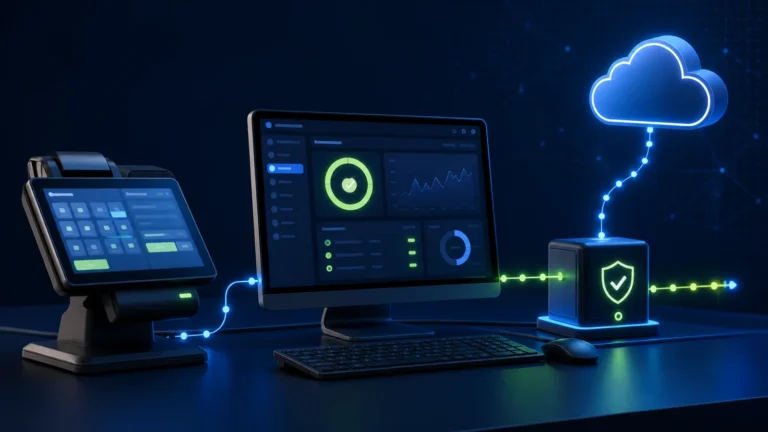

A useful SaaS agreement should state who owns the business data, how it can be exported, how backups and restoration work, what support is included, how prices may change, what happens after non-payment and how the business can leave without losing essential records.
Why subscription terms matter
SaaS software can reduce the need for local servers and make updates easier. It can also create risk if the business does not understand its rights and responsibilities.
Problems usually appear later: a branch is charged separately, a required report is treated as customization, a payment is delayed, or the business wants to move to another system. A clear agreement reduces uncertainty.
1. Identify the parties and the service
The agreement should name the customer, software provider and any hosting or third-party services that materially affect delivery.
It should also describe the actual product, plan, modules, users, branches, storage limits and integrations being purchased.
2. Confirm business-data ownership
The customer should understand that operational data entered into the system remains its business data. The agreement should separate:
- Customer data and uploaded documents
- Software source code and platform design
- Provider-created templates or reports
- Third-party licensed components
- Aggregated or anonymized service statistics
Ownership of the software does not automatically mean ownership of the customer's records.
3. Define data access and export
Ask which data can be exported, in what format and by which user role. Useful exports may include:
- Products and services
- Customers and suppliers
- Invoices and payments
- Stock movements
- Receivables and payables
- Reports and audit logs
- Documents and attachments
Test a sample export during the buying process. A promise of data ownership is weak if the records cannot be practically retrieved.
4. Specify what happens when the contract ends
The agreement should define an exit window during which the customer can download or request its data. It should also explain:
- How long data remains available after termination
- Whether an export fee applies
- Which formats are provided
- Whether attachments are included
- When data will be deleted
- Whether the provider can assist migration
Exit planning is not a sign of distrust. It is normal business continuity planning.
5. Clarify backups and restoration
Backup frequency alone is not enough. The contract or service document should explain retention, storage location, restoration responsibility and any recovery limits.
Ask whether the provider has tested restoration and whether accidental deletion by the customer is covered.
6. Define availability and planned maintenance
Some businesses need the software during specific hours, while others operate around the clock. Confirm expected availability, maintenance windows and how major service interruptions are communicated.
Not every small business needs a complicated service-level agreement, but critical operations need realistic expectations.
7. Explain support channels and scope
Support may include WhatsApp, phone, email or ticketing. The agreement should distinguish:
- Bug correction
- User guidance
- Data correction
- Configuration change
- New report
- Custom feature
- Third-party integration issue
- On-site visit
This prevents every request from being treated as free support or every problem from being treated as paid customization.
8. Set response and escalation expectations
Define how urgent issues are reported and who can escalate them. A complete outage should not follow the same process as a minor report-format request.
The customer should also provide authorized contacts so the provider does not accept sensitive changes from unknown staff.
9. Document pricing and renewal
Record setup fees, subscription amount, billing frequency, taxes, user or branch charges, storage limits and integration costs.
Also confirm:
- Automatic or manual renewal
- Notice period for price changes
- Late-payment handling
- Upgrade and downgrade rules
- Refund policy where applicable
- Charges for additional training or support
10. Understand suspension and non-payment
A provider needs a fair process for unpaid accounts, but immediate lockout can damage a business. The agreement should explain reminders, grace period, restricted access and final termination.
Where possible, export rights should remain available during a reasonable exit period.
11. Define customization ownership and maintenance
Custom work may be built only for one customer or added to the main product. Confirm whether it will be maintained after platform updates and whether the customer has paid for exclusive ownership.
A one-time customization fee does not automatically transfer the entire platform source code.
12. Cover third-party dependencies
Payment gateways, messaging services, tax APIs, cloud hosting and other providers may have separate pricing and availability. The contract should identify which costs and failures are outside the software vendor's direct control.
13. Require reasonable security practices
Ask about user permissions, password controls, encrypted connections, backup access, logging and staff access to production data. Sensitive credentials should not be shared in public files or ordinary chat groups.
14. Include confidentiality and permitted use
Both parties may receive confidential business information. The agreement should restrict unnecessary disclosure and define who may access the system.
15. Keep a change-request process
As the business grows, requirements change. A written change process should describe scope review, quotation, approval, testing and release.
Questions to ask before signing
- Can we export all essential records today?
- What happens if the subscription is not renewed?
- How long is data retained after termination?
- Who is responsible for backups and restoration?
- What support is included?
- How are price increases communicated?
- Which third-party charges are separate?
- Who maintains custom features after updates?
Our SaaS vs one-time software licence comparison provides a wider cost and ownership framework.
Frequently asked questions
Does paying a subscription mean the business does not own its data?
No. Software access and business-data ownership are different issues. The agreement should clearly protect practical access and export rights.
Should a small business use a written SaaS agreement?
Yes. Even a simple written agreement or approved quotation should cover the plan, price, support, data access and termination.
Is unlimited support realistic?
The phrase can be misleading. It is better to define included support and separate new development, major data work and on-site services.
Review the software commitment, not only the monthly price
NexZion Solutions provides transparent planning for SaaS, cloud and custom business-software projects.
Request Software ConsultationCompare Pricing ModelsNexZion Solutions publishes practical guides based on business-software, compliance-workflow, website and automation implementation experience in Pakistan.