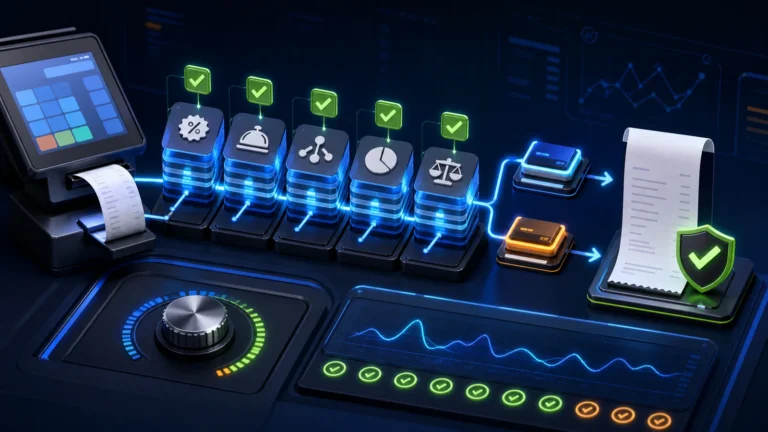

Look for branch-based permissions, central product control, stock by location, transfer approvals, branch and consolidated reports, cashier shifts, purchasing rules, price and discount controls, audit logs, reliable backups and a tested plan for internet interruptions. Confirm how the system handles branches before opening the second location.
Why a normal single-store POS becomes difficult
A single-store system may work well until the owner opens another branch. Then questions appear immediately: who can change prices, where stock belongs, how transfers are approved, whether customer balances are shared and which report is the official total.
Without a clear branch model, staff may create duplicate products, transfer stock outside the system, share administrator accounts or combine cash reports manually. Multi-branch software should remove these workarounds while preserving accountability at each location.
Choose the branch architecture first
The system may be fully cloud-based, locally hosted with central synchronization, or hybrid. Each model has advantages and responsibilities.
| Model | Strength | Important question |
|---|---|---|
| Central cloud system | All branches use one maintained online database and owners can view data centrally. | What happens during an internet interruption, and how is data backed up? |
| Local branch databases with synchronization | Branches may continue locally when connectivity is unreliable. | How are duplicate transactions, failed sync and conflicting changes resolved? |
| Head-office server with branch connections | The business retains more infrastructure control. | Who manages the server, security, connectivity and disaster recovery? |
| Hybrid or offline-capable approach | Can combine central control with limited offline operation. | Which transactions are available offline and when do they synchronize? |
Do not accept “works offline” without a demonstration. Ask what staff can do offline, what information may be outdated and how failed synchronization becomes visible to management.
1. Branch-based users and permissions
Every employee should use an individual account. Cashiers may create sales, while managers approve discounts, refunds or stock adjustments. A branch manager should not automatically see or edit another branch unless the business requires it.
Essential permission controls include:
- Access limited by branch or warehouse.
- Separate rights for sales, purchases, stock, accounts and reports.
- Manager approval for discounts, returns and voids.
- Restrictions on cost price, profit and sensitive reports.
- Administrator rights limited to authorized personnel.
- Audit history showing user, date, branch and action.
2. Central product and barcode management
Products should not be recreated independently at every branch. A central catalogue reduces duplicate codes, inconsistent names and different barcode assignments.
Decide who can:
- Create and deactivate products.
- Assign categories, brands, units and barcodes.
- Change cost and sale prices.
- Define branch-specific availability.
- Maintain tax or regulatory fields where applicable.
- Import new items in bulk.
Where products use cartons, boxes, pieces, kilograms or litres, unit conversions must remain consistent across locations. A branch should not interpret “one box” differently from the warehouse.
3. Centralized and branch-specific pricing
Some businesses require one national or regional price. Others allow branch-specific pricing because of rent, competition or local promotions. The POS should represent the approved policy rather than letting staff change prices informally.
Useful controls include effective dates, promotion periods, customer-group pricing, maximum discount limits and approval logs. When prices are updated centrally, confirm when each branch receives the change and what happens if a branch is offline.
4. Stock by branch and warehouse
The owner needs a consolidated total, but operational users need accurate quantities for their own location. The system should show stock by branch, warehouse, shelf or department where required.
Reports should distinguish:
- Available stock.
- Reserved or committed stock.
- Stock in transit.
- Damaged, expired or quarantined items.
- Negative stock and unexplained variance.
- Reorder levels by location.
A single combined quantity can mislead staff. Ten units in Lahore do not help a customer standing in Pakpattan unless the transfer or delivery process is clear.
5. Controlled stock transfers
A transfer is not simply a stock decrease at one branch and increase at another. It should have a request, approval, dispatch, transit and receipt process.
| Stage | Responsible action | Control |
|---|---|---|
| Request | Receiving branch asks for required items. | Requested quantity and reason recorded. |
| Approval | Authorized person confirms the transfer. | Available stock and authority checked. |
| Dispatch | Sending location packs and releases goods. | Dispatch document and user recorded. |
| In transit | Goods are no longer available at the source but not yet received. | Visible transit status. |
| Receipt | Destination confirms actual quantity. | Shortage or damage recorded. |
Ask whether the system supports partial receipt, rejected items and transfer cancellation. These exceptions are common in real operations.
6. Purchasing and central warehouse planning
Some businesses purchase independently at each branch. Others use central procurement and distribute stock. The POS or ERP should support the chosen model.
Clarify whether purchase orders, supplier invoices, receiving and payments belong to the branch or head office. If the central warehouse buys goods, the branch should receive stock through a transfer rather than a duplicate purchase.
7. Cashier shifts and daily closing
Multi-branch owners need branch cash control, not only consolidated sales. Each cashier should open and close a shift with recorded cash, card and other payment totals.
A useful closing report includes:
- Opening cash.
- Sales by payment method.
- Refunds and returns.
- Cash paid out or received.
- Expected closing amount.
- Physical cash counted.
- Shortage or excess with explanation.
- Manager review and timestamp.
Head office should see unresolved differences without being able to silently change the cashier’s original count.
8. Customer, loyalty and credit policy
Decide whether customers are shared across all branches. A shared record can improve service and loyalty, but it also requires clear rules for duplicate phone numbers, credit limits, returns and privacy.
For customer credit, confirm whether the limit is company-wide or branch-specific, who can approve it and where payments may be collected. The system should avoid one branch extending credit without seeing an existing balance at another location.
9. Consolidated and branch-level reporting
Management needs both views. Consolidated reporting shows the business total, while branch reporting identifies responsibility and performance.
Important reports include:
- Sales, gross profit and returns by branch.
- Product and category performance.
- Stock value and ageing by location.
- Transfers pending dispatch or receipt.
- Cashier shortages and excesses.
- Discounts, refunds and voided transactions.
- Customer and supplier balances.
- Purchasing and stock replenishment.
- User activity and audit logs.
Ask how reports handle transactions posted late, backdated entries and branch time differences.
10. Internet outage and synchronization controls
Connectivity planning is essential in Pakistan. The provider should explain what the branch can do during an outage and how the owner will know whether all transactions reached the central system.
Questions to test:
- Can a cashier create sales without internet?
- Are current prices and stock available offline?
- How are invoice numbers controlled?
- What happens when the same record changes in two places?
- Does the system retry automatically?
- Can management see failed or pending synchronization?
- How are duplicates prevented?
11. Security, backup and business continuity
Multi-branch access increases the number of devices, users and networks that can affect the system. Use individual accounts, strong passwords, role-based access and prompt removal of former employees.
Backups should cover the complete database and important files. Confirm where they are stored, how often they run, who monitors failures and when restoration was last tested.
Each branch also needs basic continuity planning for power, internet, printer and device failure. A cloud backup does not replace a working counter and a UPS does not replace a database backup.
12. FBR, PRA and branch identifiers
Where the business uses FBR POS, Digital Invoicing, PRA or another connected system, confirm the current registration and branch requirements before configuration. Branch, POS, invoice, buyer and product mappings may differ according to the applicable workflow.
The software provider should not promise compliance merely because a logo or API button exists. Test successful submissions, errors, retries, printed invoices and reconciliation for each relevant location.
Implementation plan for a growing retailer
- Map existing and planned branches, warehouses and counters.
- Define central versus branch responsibilities.
- Clean the product, barcode and unit catalogue.
- Design pricing, discounts and approval rules.
- Define purchasing and transfer workflows.
- Configure users and branch access.
- Import and verify opening stock by location.
- Test complete transactions and outage scenarios.
- Pilot one branch or counter.
- Roll out additional branches with a repeated checklist.
Questions to ask before buying multi-branch POS
- How many branches, warehouses, counters and users are included?
- Can users be restricted to one branch?
- Can products and prices be controlled centrally?
- How are transfers approved, dispatched and received?
- Does stock in transit appear separately?
- Can the system continue during an internet interruption?
- How are failed synchronization and duplicates handled?
- Are reports available by branch and consolidated?
- How are backups monitored and restored?
- Can the business export its data?
- What training and rollout support are included?
- Which integrations or custom requirements cost extra?
Multi-branch readiness checklist
Frequently asked questions
Can one POS manage multiple branches?
Yes, when the system supports branch-level users, stock, transfers, pricing and reporting. The exact setup depends on whether data is centralized, synchronized or hosted locally.
Should every branch have a separate database?
Not necessarily. A central database simplifies consolidated control, while local databases may support offline operation. The business should compare connectivity, synchronization risk, security and support responsibilities.
Can branches use different prices?
They can when the software supports branch-specific price lists and the business has an approved policy. Price changes and discounts should remain controlled and auditable.
Does NexZion POS support growing retailers?
NexZion POS includes plans for different business sizes. Multi-location, advanced inventory and related requirements should be confirmed in a demonstration and written scope before implementation.
Plan the branch structure before expansion
Review the product, pricing and demonstration pages, then share your branches, counters, warehouse and current workflow for a practical recommendation.
Explore NexZion POS · Review POS pricing · Request a multi-branch demo
NexZion Solutions publishes practical guides based on business-software, compliance-workflow, website and automation implementation experience in Pakistan.