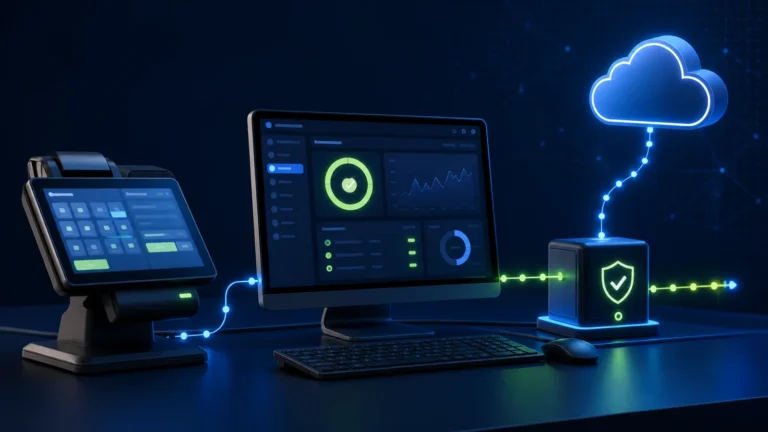

Do not judge a software demo only by dashboard design. Check whether it supports your real transactions, staff roles, reports, branches, integrations, backups, data export, implementation plan and total ongoing cost.
Why businesses make weak decisions during demos
Most demos are designed to show the strongest parts of a product. The presenter already knows which buttons to press, the sample data is clean and difficult exceptions may not appear. Your business will not operate under those perfect conditions.
A proper evaluation should therefore move beyond a general tour. Give the vendor realistic examples from your business and ask them to complete the full process in front of you.
1. Can the system complete our real workflow?
Prepare one normal transaction and one difficult transaction. For a retailer, this may include a sale, return, discount and stock adjustment. For a distributor, it may include order booking, dispatch, credit sale, recovery and customer balance.
Ask the presenter to complete the process without skipping steps or saying that a feature can be added later.
2. Which features are already available?
Separate existing features from planned customization. A written quotation should clearly identify:
- Features available in the current version
- Configuration included in setup
- Custom development charged separately
- Third-party services and subscriptions
- Features promised for a future release
This prevents a business from purchasing a roadmap instead of a working solution.
3. How are users and permissions controlled?
Ask to see different user roles. A cashier, manager, storekeeper and accountant should not have the same access. Check who can change prices, delete transactions, backdate entries, approve discounts and view sensitive reports.
4. What happens when a mistake is made?
Real systems need controlled correction. Ask how the software handles:
- Wrong invoice
- Cancelled sale
- Customer return
- Incorrect stock receiving
- Duplicate payment
- Backdated transaction
- Unauthorized edit
Good software preserves an audit trail instead of silently replacing history.
5. Are the reports based on our definitions?
Words such as profit, stock value, outstanding balance and daily cash can mean different things. Ask the vendor to explain the calculation behind each important report.
Also confirm whether reports can be filtered by branch, date, user, product, customer, supplier and payment method.
6. Can the software support our branches and counters?
Multi-branch support is more than creating several locations. Confirm branch-wise users, stock, pricing, transfers, closing, permissions and consolidated reporting.
7. How will existing data be migrated?
Ask which records can be imported and who will clean them. Common data includes products, customers, suppliers, opening stock, receivables, payables and chart of accounts.
Request a small sample import before approving a large migration.
8. Where is the data stored?
Confirm whether the software is cloud-hosted, installed locally or hybrid. Ask who manages the server, backups, updates, monitoring and recovery.
Our cloud vs on-premise comparison explains the operational responsibilities of each option.
9. Can we export our data?
Data ownership should be tested, not assumed. Ask for an example export of products, customers, invoices, payments and reports. Confirm the format and whether export remains available if the service ends.
10. How do backups and restoration work?
A backup is useful only if it can be restored. Ask:
- How often backups are created
- Where copies are stored
- How long they are retained
- Who can restore them
- When restoration was last tested
11. Which integrations are included?
If the project involves FBR, PRA, WhatsApp, payment gateways, ecommerce, biometric devices or another ERP, ask to see the actual integration workflow and error handling.
Also confirm any third-party fees and usage limits.
12. What happens when the internet is unavailable?
Cloud systems normally need connectivity. Ask whether the business can continue working, which functions stop and how pending transactions synchronize later.
13. What training and implementation are included?
A demo proves that the vendor can use the software. Implementation proves that your team can use it correctly. Confirm data preparation, configuration, user training, testing, go-live support and responsibility for opening balances.
14. What is the complete three-year cost?
Compare setup, subscription, hosting, support, updates, integrations, customization, hardware and future user or branch charges. A low first-year price can become expensive when essential items are excluded.
Use our SaaS vs one-time licence guide to compare pricing models.
15. What support response can we expect?
Ask which channels are available, support hours, escalation process, response targets and what counts as paid customization. Request these points in the agreement.
A practical demo scorecard
Score each vendor from 1 to 5 in these areas:
- Workflow fit
- Ease of use
- Permissions and audit trail
- Reports
- Data migration
- Integrations
- Security and backups
- Training and support
- Total cost
- Future scalability
The highest score should not automatically win. Any serious weakness in data control, support or workflow fit may be a reason to reject the system.
Frequently asked questions
How long should a software demo take?
A useful first demo may take 30 to 60 minutes, but complex ERP or custom software decisions normally require a second session with detailed workflows.
Should we ask for a trial account?
Yes, when possible. A controlled trial helps users test common tasks, but it should not replace implementation planning and data review.
Who should attend the demo?
Include the owner or decision-maker plus staff who will actually use the system, such as a cashier, accountant, storekeeper or branch manager.
Compare software with your real workflow
NexZion Solutions can demonstrate POS, ERP, FBR Digital Invoicing, websites and automation using examples closer to your business process.
Request a Free DemoOpen Comparison GuidesNexZion Solutions publishes practical guides based on business-software, compliance-workflow, website and automation implementation experience in Pakistan.