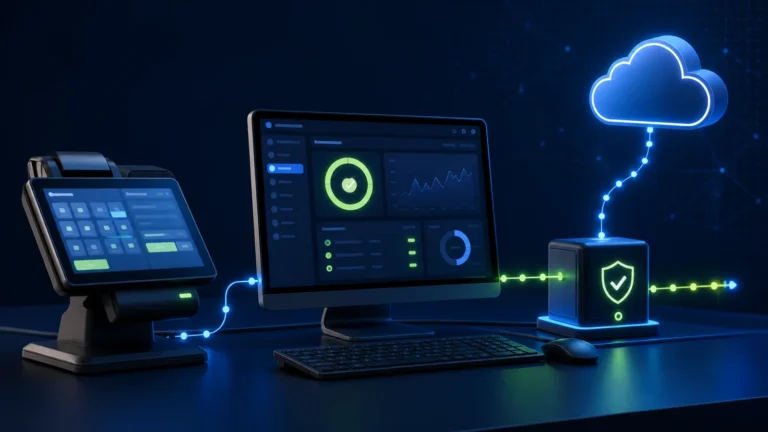

Useful workflows include product-enquiry capture, quotation preparation, customer follow-up, low-stock and unusual-adjustment alerts, purchase requests, receivable reminders, stock-transfer exceptions, arrival and dispatch notifications, daily summaries and support routing. The main transaction record should remain in reliable POS, inventory or ERP software.
Why operational businesses need more than a chatbot
A retailer or cold storage operator does not only answer customer questions. The business must preserve quantities, rates, units, locations, receivables, approvals and transaction history.
A chatbot alone cannot provide dependable operational control. AI should support the workflow around the system of record: collecting requests, summarizing information, creating tasks, identifying exceptions and helping staff respond.
Use POS or ERP as the source of truth
Sales, stock, purchases, customer balances and dispatch records should come from maintained business software. Automation can read or update approved fields where integration is available.
Do not allow AI to invent stock availability, customer balance or product price from an old document or previous message.
Workflow 1: Product and bulk-order enquiries
A retailer, wholesaler or distributor may receive enquiries through WhatsApp, Facebook or the website. The workflow can collect:
- Product or brand
- Required quantity and unit
- Customer or business name
- Location
- Delivery or pickup requirement
- Preferred contact time
If reliable inventory access exists, approved availability can be checked. Otherwise, a confirmation task should be created for sales staff.
Workflow 2: Quotation requests
For repeat products or services, automation can create a quotation draft using approved prices and customer details. Large discounts, special credit terms and transport commitments should require human approval.
The automated quotation workflow guide explains how to preserve version control and approvals.
Workflow 3: Customer-credit follow-up
A trading business may have many customers with outstanding balances. Automation can:
- Create due-date reminders
- Prepare an internal recovery list
- Assign follow-up to the salesperson
- Record customer response
- Escalate disputed balances
- Stop messages after payment or opt-out
Customer-facing amounts must come from approved accounts or ERP records. Disputes and payment arrangements require staff review.
Workflow 4: Low-stock and reorder alerts
The inventory system can identify products below a defined level. Automation can notify the responsible purchase or branch manager and create a replenishment task.
Reorder rules should consider sales demand, pending purchase orders, supplier lead time, seasonal requirements and reserved stock. A low quantity alone may not justify an automatic purchase.
Workflow 5: Purchase-request routing
A branch or department can request stock or supplies through a structured form. The workflow records item, quantity, reason, required date and current availability.
Requests can be routed according to value, category and authority limits. The business should define who approves and who purchases.
Workflow 6: Stock-adjustment alerts
Stock adjustments for damage, expiry, count differences or corrections can create management alerts, especially when the quantity or value exceeds a threshold.
The system should preserve the reason, user, time and approval. Automation should not silently correct stock to make reports agree.
Workflow 7: Branch transfer exceptions
For multi-branch businesses, automation can highlight transfers that are dispatched but not received, partially received, damaged or overdue.
A proper transfer should include request, approval, dispatch, in-transit status, receiving confirmation and difference resolution. Review the multi-branch stock transfer guide.
Workflow 8: Cold storage arrival and dispatch communication
A cold storage business can organize requests related to:
- Expected arrival
- Customer and commodity details
- Vehicle or transport information
- Chamber or storage request
- Dispatch authorization
- Pending documentation
- Customer notification
The final weight, quantity, charges and storage record should remain in the ERP or approved operational system.
Workflow 9: Storage and service reminders
Based on approved records, automation can create reminders for pending dispatch, overdue payment, expiring agreement, required inspection or customer follow-up.
The workflow should distinguish an internal reminder from a customer commitment. Staff must review exceptional cases.
Workflow 10: Daily owner summary
A management summary may include:
- Sales and collections
- Purchases and payments
- New customer enquiries
- Overdue receivables
- Low-stock items
- Large stock adjustments
- Transfers pending receipt
- Cold storage arrivals and dispatches
- Failed integrations or reports
Every figure should have a defined source and calculation. A summary should not combine unverified chat messages as if they were accounting records.
Workflow 11: Supplier communication and follow-up
The purchasing team can track quotations requested, delivery dates promised and supplier responses. Internal reminders can highlight orders that need confirmation.
Automated purchase commitments should only be used where management has defined clear authority and limits.
Workflow 12: Customer-support routing
Product complaint, return request, delivery issue, balance question and technical problem should not all go to the same person. The workflow can identify the issue and route it with order, invoice or customer reference.
Units and conversions need strict control
Retailers and traders may purchase cartons and sell pieces, kilograms, grams, litres or packs. Cold storage businesses may record bags, crates, kilograms or other operational units.
Conversions must be product-specific and controlled in the business software. AI should not infer a conversion from the product name.
Permissions and approvals
Different roles should have different access. A salesperson may view customer and product information without changing stock. A storekeeper may receive goods without approving payment. A manager may approve discounts or adjustments within defined limits.
Automation should respect these permissions and create an audit record for important actions.
Data and integration readiness
Before implementation, confirm:
- Products and units are clean.
- Customer and supplier records are not heavily duplicated.
- Branches and warehouses are defined.
- Opening balances are approved.
- POS or ERP provides suitable integration access.
- Users and authority limits are documented.
- Reports have agreed definitions.
Poor master data will make automated alerts and customer replies unreliable.
What should stay human?
Human review should remain for:
- Major discounts and credit terms
- Customer disputes
- Supplier selection
- Unusual stock differences
- Damage and write-off decisions
- Legal or tax interpretation
- Large purchase commitments
- Operational emergencies
Recommended first project
A practical first phase for a local retailer or trader is customer-enquiry capture plus quotation follow-up. For a cold storage business, a useful first phase may be pending-arrival, dispatch and receivable reminders from approved ERP records.
After measuring the result, more workflows can be added safely.
NexZion Solutions provides AI Automation Services in Pakpattan, POS Software in Pakpattan, ERP development and Business Automation Services.
Connect automation with real operational software
Discuss your retail, trading, inventory or cold storage workflow with NexZion Solutions and identify a practical first automation phase.
Discuss Operational AutomationNexZion Solutions publishes practical guides based on business-software, compliance-workflow, website and automation implementation experience in Pakistan.